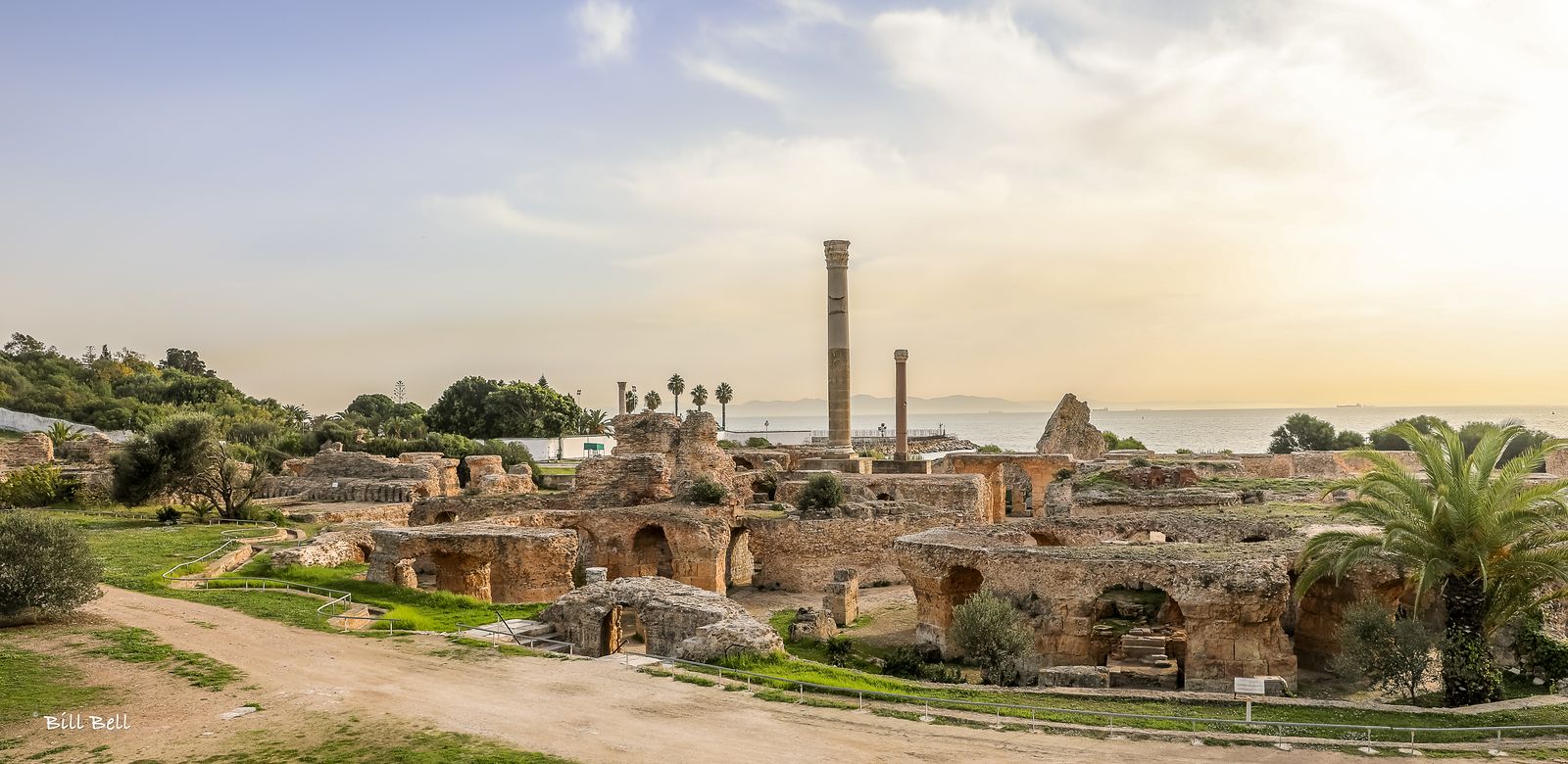
Roman bath ruins with two tall columns

Tunisia

In December 2022 we were in Tunisia, among the ruins of Carthage, the blue and white of Sidi Bou Said and the lanes of old Tunis. 62 photographs.

HomeAll galleriesNext gallery: Jordan →

The Antonine Baths, Carthage

Carthage was founded by the Phoenicians, destroyed by Rome in 146 BC and then rebuilt as a Roman city. I photographed what is left of its great seaside baths: arches, fallen columns and carved stone.

The Antonine Baths at Carthage, spreading out toward the sea.
Late light over the vaults and columns.
A fallen column points across the site.
Sections of column laid in a row.
A row of arches behind a block of veined marble.
Two columns stand above the broken walls.
A single column seen over the top of a vault.
Low arches and tumbled blocks.
One doorway leads to another.
Columns old and pale against the masonry.
Broken columns waiting in the grass.
A weathered pier under a bright, clouded sky.
Carved blocks set down where they can be seen.
The leaves of a fallen capital are still crisp.

Around Carthage

The ancient city is scattered through a modern suburb, so a theatre, a mosaic or a Punic tomb turns up between houses and gardens.

The curve of the seats at the Roman theatre of Carthage.
Row upon row of stone seats.
A resident of the ruins.
Part of a mosaic floor, open to the sky.
A small doorway under the greenery.
A marble head in profile.
Figures in relief, resting against a wall.
Latin lettering on a broken column.
Ruins in a garden of palms.
The Acropolium, the former Cathedral of Saint Louis, on Byrsa Hill at Carthage.
A mosque and minaret near the site.
Across the Gulf of Tunis to the twin-peaked mountain of Bou Kornine.

Sidi Bou Said

Up the coast from Carthage is Sidi Bou Said, where white walls and blue doors and shutters look over the Gulf of Tunis.

Sidi Bou Said: white walls, blue woodwork and a cafe umbrella to match.
A stepped lane with rugs hung out for sale.
Oranges beside a blue and white doorway.
A quiet lane behind the shops.
Shops spill onto the paving.
Every inch of the shopfront is in use.
Painted plates cover the wall.
Two men take their time over a drink.

Central Tunis

In the middle of the capital, French-era avenues run up to the old city.

Bab el Bhar, the old Sea Gate between the medina of Tunis and the newer city.
The Cathedral of Saint Vincent de Paul in Tunis, its twin towers behind the palms.
The white front of the Municipal Theatre of Tunis, with people resting on its steps.
The clock tower against a clear sky.
The city says it in red letters.
A grand corner building with balconies.

In the medina

The medina of Tunis is a World Heritage site and a working market. Its doors alone could keep a photographer busy.

Bags and clothes crowd an arched passage.
A corridor of bright dresses.
Cones of spice on little stands.
Jars to the ceiling.
Robes on display against a blue shutter.
A gilded bed among woven rugs.
An old door with ironwork and studs.
Blue, with a pattern picked out in black studs.
A red door with two knockers.
Yellow under a striped arch.
A seller sets out wares by a yellow door.

From the rooftops

From a roof terrace lined with old tiles, the medina opens out into domes and minarets.

Tiled arches around the terrace.
A tiled arch frames the city.
A minaret beyond the terrace railing.
Domes in front, towers behind.
The carved face of a minaret.
Green tiles and an octagonal minaret.
A wall of patterned tiles.

People

As a community newspaper photographer I learned that a place is its people. These are some of the faces of Tunis.

A direct, steady look.
A red cap and yellow glasses.
A violinist plays on the pavement.
Two women pause for the camera.