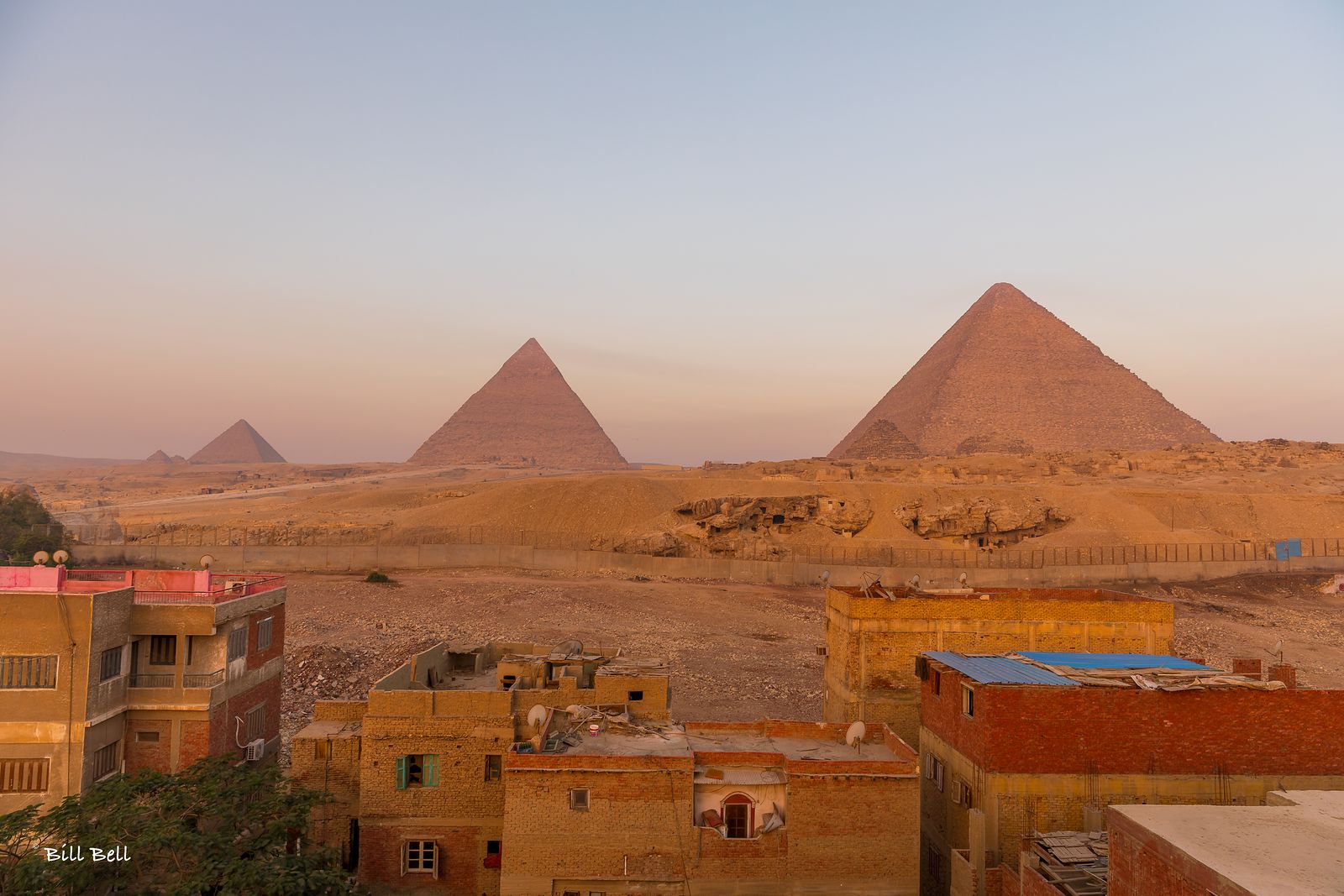
Three pyramids behind brick buildings at dusk

Egypt

In December 2022 we went to Egypt, from the plateau at Giza to the tombs of Saqqara and the streets of Cairo. 47 photographs.

HomeAll galleriesNext gallery: Tunisia →

The pyramids of Giza

I photographed the pyramids from the rooftops, from the sand and from close under the blocks. They were built about 4,500 years ago, and the city now comes almost to their feet.

Two pyramids in the orange light at the end of the day.
The pyramids seen beyond the rooftops.
One pyramid catches the last warm light.
The pyramids lit up after dark.
The sun sets over the city.
Large and small pyramids above a field of broken stone.
The pyramids from out in the sand.
A horse and rider cross in front of the pyramid.
Visitors look small against the blocks.

The Sphinx

The Great Sphinx has the body of a lion and a human head, cut from the bedrock at Giza. I like it best with a pyramid behind, which gives you its size.

The head of the Sphinx against a clear sky.
The Sphinx in profile with a pyramid behind.
The whole length of the Sphinx.

Camels and the people of the plateau

The plateau is a workplace as much as a monument. I turned my camera to the camels, their bright saddle cloths and the men who make their living beside them.

Camels waiting in their saddle cloths.
Two camels rest on the sand.
A close look from a camel in tassels.
Camels and carts pass below the pyramid.
Two men in long robes on the stone ground.
A man takes a rest in the sun.

Saqqara

Saqqara is where the Step Pyramid of Djoser stands, more than 4,600 years old. Inside the nearby tombs, the walls show cattle, fish, boats and people at work, some still holding their colour.

The Step Pyramid of Djoser at Saqqara, six great stages against a deep blue sky.
Carved cobras along a wall, with the step pyramid beyond.
The tall entrance wall, with the pyramid behind.
Two pyramids across the sand, one stepped and one worn.
A painted figure that has kept its colour.
A painted scene full of movement.
Figures carved side by side.
Cattle and a calf in a carved farm scene.
A wall full of fish.
Men in a boat above a river of fish.
A line of horned cattle.

An open-air statue park

This open-air collection gave us sphinxes among the palms, seated figures and a colossus so large it is displayed lying on its back.

A sphinx resting among the palms in the open-air museum at Memphis.
Three seated figures beside a carved column.
The fallen colossus of Ramesses II, lying on its back in its own museum at Memphis.
Fine pleats and carved signs on the colossus.
A crowned head between two smaller ones.

In the museum

At the Egyptian Museum in Cairo I looked for faces. After thousands of years, many of them still seem to look straight back.

A seated figure, cross-legged and watchful.
The painted statue of the dwarf Seneb with his wife, arm round him, and their two children below.
A face that still looks straight back.
A sphinx statue against black.
Polished stone in warm light.

Cairo streets

Away from the monuments is the Cairo I was trained to look for as a newspaper photographer: shopfronts, fruit stands, horse carts and tuk-tuks sharing the road.

Dresses and scarves outside a shop.
Fruit hangs over a corner drink stand.
A horse cart loaded with bales.
A rider on a grey horse in the traffic.
A donkey cart comes down the road.
A carriage, palms and a man walking.
A three-wheeled taxi parked by a doorway.
A round Roman tower of the old Babylon Fortress in Coptic Cairo, banded in brick and stone.